
Isometric Mid-Thigh Pull (IMTP): a testing guide
The isometric mid-thigh pull (IMTP) is the standard force plate test for maximal strength. Here's what it measures, why it's isometric, and how to set it up.
Published July 28, 2026 · 7 min read
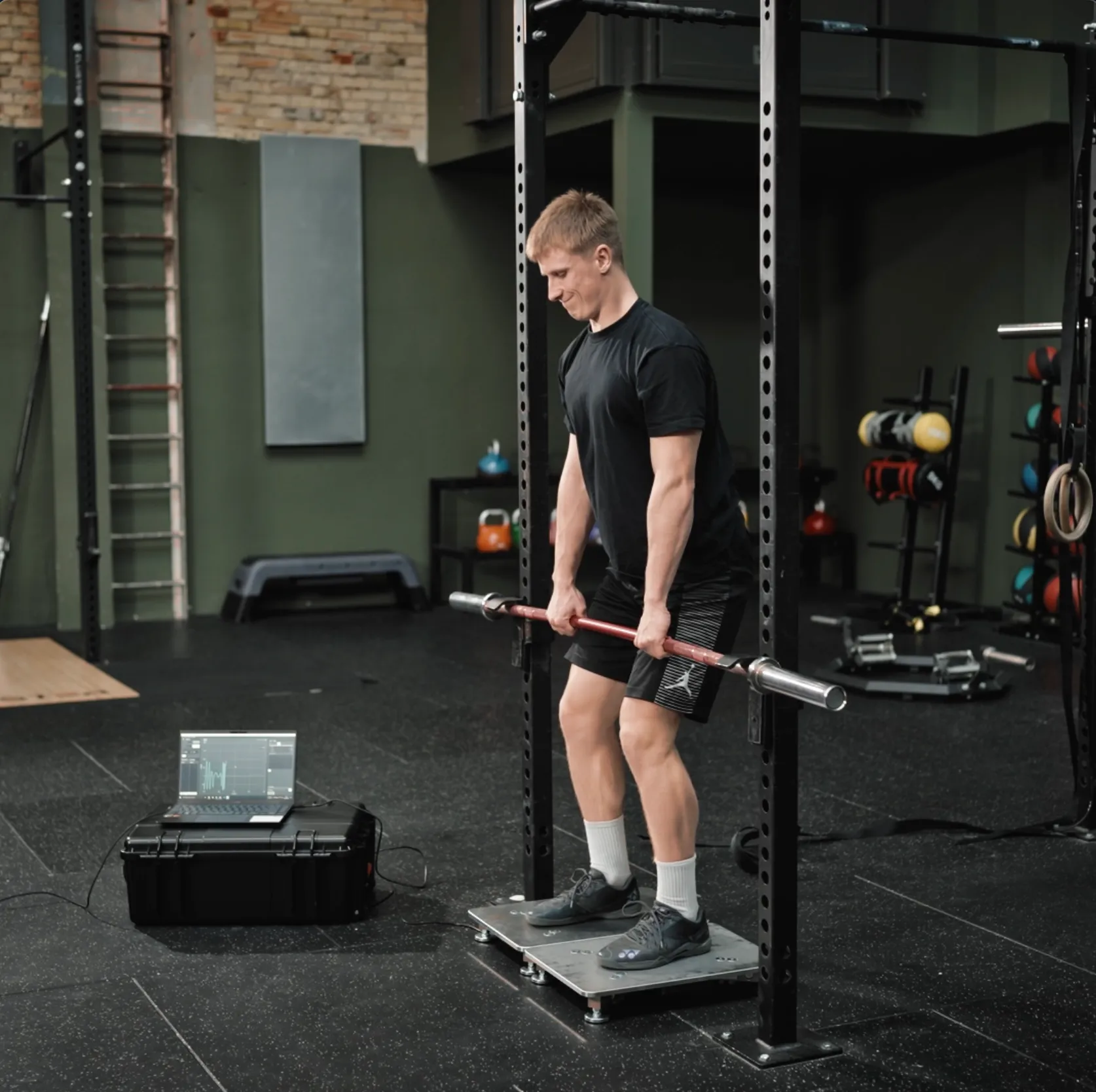
The isometric mid-thigh pull (IMTP) is a maximal-strength test in which an athlete stands on a force plate and pulls as hard as possible against a fixed, immovable bar set at mid-thigh height. Because the bar doesn’t move, the effort is isometric: the muscles produce force without changing length, and the force plate records exactly how much force the athlete puts into the ground and how quickly they produce it.
It has become the reference test for lower-body maximal strength in sports science, because it delivers that information in a few seconds with almost none of the fatigue or injury risk of a one-rep-max lift.
What is the isometric mid-thigh pull?
The position mimics the “second pull” of a clean, the most powerful moment of a weightlifting movement. The athlete stands tall on the plate, grips a bar fixed at mid-thigh (roughly the mid-point between the knee and the hip crease), and on the command pulls upward against it as hard and as fast as they can for a few seconds.
Nothing moves. The bar is anchored to a frame or rack, so instead of lifting a load the athlete drives force down through their feet into the force plate. What the plate measures is that ground reaction force, rising from a quiet standing baseline (the athlete’s bodyweight) up to a peak as the pull reaches maximum.
What does the IMTP measure?
A single pull produces two headline qualities and several supporting metrics:
| Metric | What it tells you |
|---|---|
| Peak force | Maximal strength, the most force the athlete can produce |
| Rate of force development (RFD) | Explosive strength, how quickly force is produced |
| Force at time bands (e.g. 100 ms, 200 ms) | How much force is available early, when it matters for sport |
| Impulse | Total force applied over the pull |
| Asymmetry (left vs. right) | Imbalance in force between limbs |
Peak force answers “how strong is this athlete?” Rate of force development answers “how fast can they express that strength?” That’s a crucial distinction, because most sporting actions happen in under 250 ms, far too quickly to reach peak force. Two athletes with identical peak force can develop it at very different speeds.
Why test strength isometrically?
Isometric testing has practical advantages that explain its popularity:
- Safe and low-fatigue. There’s no external load to drop and no eccentric lowering, so it barely tires the athlete. You can test it frequently, even in-season or mid-rehab.
- No 1RM required. You get a maximal-strength measure without loading a bar to failure, which is safer and faster than a true one-rep max.
- Highly repeatable. With the body position fixed, the IMTP is one of the most reliable strength tests available, which is what you want when you’re tracking small changes over time.
- Technique-light. It doesn’t demand the skill of a barbell lift, so you’re measuring strength rather than an athlete’s proficiency with the movement.
How does a force plate capture the IMTP?
At rest, the plate reads the athlete’s bodyweight, a flat line on the force-time curve. When the athlete pulls against the fixed bar, that force is transmitted through the body and into the plate, so the curve rises. The highest point it reaches is peak force; subtracting bodyweight gives net peak force, the athlete’s own contribution.
Rate of force development is read from the steepness of that rise: how fast the curve climbs in the first fractions of a second, usually reported over defined windows such as 0–100 ms and 0–200 ms. And because a dual plate measures each foot separately, the same pull reveals left–right asymmetry in how force is shared between limbs.
How to perform an IMTP on a PlateMate
The IMTP needs the force plates plus a fixed bar to pull against. On a PlateMate setup that’s either the IMTP Platform (a base the plates sit on, with a strapped bar) or the IMTP Extension for Squat Rack (a bar mounted in a standard rack). The protocol is the same either way. After a general warm-up, take a few submaximal pulls (around 50%, 75% and 90% of effort) to prime the position, then run the recorded trials:
- Set the bar to mid-thigh, roughly halfway between the top of the knee and the hip crease, with the athlete standing tall. Record the position so you can reproduce it exactly next time.
- Standardise the body position. Aim for a near-upright torso with a slight knee bend; knee angle around 125–145° and hip angle around 140–150° is the commonly used range. Whatever you choose, keep it identical across tests.
- Strap the hands to the bar so grip strength isn’t the limiting factor. You’re testing the legs and hips, not the forearms.
- Take up the slack and hold still for a moment so the software can read a clean bodyweight baseline.
- On the command, pull as hard and as fast as possible, cueing “push your feet through the floor, as fast as you can,” and hold maximal effort for about 3–5 seconds.
- Take at least two maximal trials, with a minute or two of rest between them, adding more while peak force is still climbing and stopping once it plateaus. Read peak force, RFD, and left–right asymmetry in ForceMate, and discard any trial with a countermovement (a dip before the pull); the baseline must stay flat.
For the exact step-by-step protocol, see the isometric test instructions in our Test Library.
What’s a good IMTP score?
Absolute peak force (in newtons) scales with body size, so a heavier athlete will almost always produce more force than a lighter one, which makes raw numbers a poor comparison between people. Relative peak force (force per kilo of bodyweight) is the fairer measure, but even that varies widely by sport, sex, and training age, so treat any published range as a rough guide only.
Two honest caveats matter more than a normative table here:
- Rate of force development is powerful but noisy. RFD is more sensitive to fatigue and readiness than peak force, but it’s also less reliable trial-to-trial, so read it as a trend across sessions, not a conclusion from one test.
- The within-athlete comparison matters most here too. As with every force plate metric, a change in an athlete’s own peak force or asymmetry over a training block tells you more than where they rank against a general population.
Where the PlateMate and IMTP Platform fit
The IMTP is the natural complement to jump testing. Where a countermovement jump shows explosive power and a drop jump shows reactive strength, the IMTP isolates raw maximal strength, the foundation the others are built on.
The PlateMate provides the measurement, and the IMTP Platform turns it into an isometric testing station in seconds, portable enough for a clinic, a gym floor, or the field. Peak force, RFD, and per-limb asymmetry come out of every pull, tracked over time in ForceMate, with each plate reading one leg so imbalances surface on the same test.
Getting started
If maximal-strength testing is new to your setup, start with peak force as your single headline number. Fix the bar height and body position, record them, and re-test on a consistent schedule so the numbers are genuinely comparable. Add RFD and asymmetry once your positioning is repeatable. Remember that a flat, countermovement-free baseline is what separates a trustworthy IMTP from a noisy one.
Run alongside your jump tests, the IMTP fills in the rest of the picture: how strong an athlete is, how fast they can express it, and how evenly it’s shared between limbs.
Want to see how the PlateMate and IMTP Platform work together in your setting? Get in touch with the CC Athletics team.
Frequently asked questions
What is the isometric mid-thigh pull (IMTP)?
The isometric mid-thigh pull (IMTP) is a maximal-strength test in which an athlete stands on a force plate and pulls as hard as possible against a fixed, immovable bar set at mid-thigh height. Because the bar doesn't move, the effort is isometric (the muscles produce force without changing length), and the force plate records how much force is produced and how quickly.
What does the IMTP measure?
Its two headline outputs are peak force (maximal strength, the most force the athlete can produce) and rate of force development, or RFD (how quickly that force is produced). On a dual force plate it also shows left–right asymmetry, and force at set time bands such as 100 and 200 ms.
What is the correct body position for the IMTP?
The commonly recommended position is a knee angle of about 125–145° and a hip angle of about 140–150°, with a near-upright torso and the bar set at mid-thigh, roughly halfway between the top of the knee and the hip crease. Whatever angles you choose, record them and reproduce them exactly each time, because the IMTP is only repeatable if the position is.
Why test strength isometrically instead of a one-rep max?
An IMTP gives a maximal-strength number without loading a bar to failure, so it is safer, faster and far less fatiguing than a true 1RM; you can run it in-season or mid-rehab. Because the body position is fixed it is also highly repeatable, which makes it well suited to tracking small changes over time.
What is a good IMTP score?
Absolute peak force scales with body size, so relative peak force (force per kilogram of bodyweight) is the fairer comparison. Even that varies widely by sport, sex and training age, so treat published ranges as a rough guide only. As with any force-plate metric, an athlete measured against their own baseline tells you more than a population norm.
How is the IMTP different from a countermovement jump?
A countermovement jump measures explosive power through a dynamic jump, while the IMTP isolates raw maximal strength through a held isometric pull with no movement. They are complementary: the jump shows how much power an athlete can express, and the IMTP shows the underlying strength it is built on.
The product behind this article
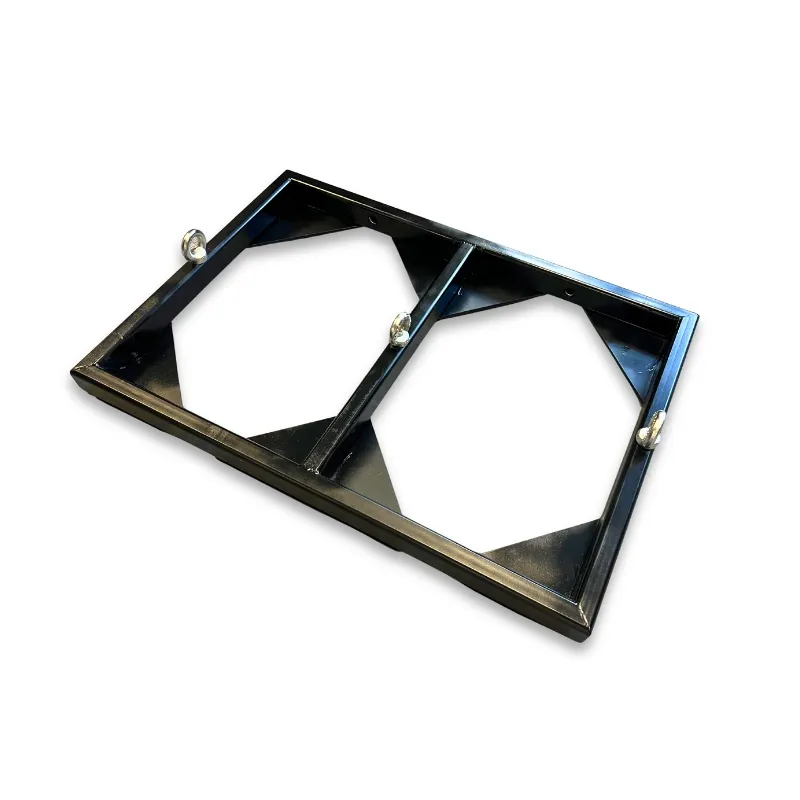
IMTP Platform
Attachment for isometric mid-thigh pull testing on PlateMate.
Explore IMTP Platform →