
Rate of Force Development (RFD), explained
Rate of force development (RFD) is how fast an athlete produces force: explosive strength. Here's what it is, why it matters, and how a force plate measures it.
Published July 29, 2026 · 5 min read
Rate of force development (RFD) measures how quickly an athlete can build force: not the maximum force they produce, but how fast they get there. It’s the metric behind “explosive strength,” and because most sporting actions are over in a fraction of a second, it’s often more relevant than maximum strength. A force plate is what measures it.
What is rate of force development (RFD)?
RFD is the rate at which force is produced: the change in force divided by the change in time. On a force-time curve it’s the slope. A steep rise means force is produced quickly, a shallow rise means slowly. It’s measured in newtons per second (N/s), and it’s often called explosive strength.
Why RFD matters
Maximum (peak) force tells you how strong an athlete is. But reaching peak force takes time, often several hundred milliseconds or more, and most sporting actions are far quicker than that: a sprint foot-strike, a jump take-off, a change of direction all happen in well under 250 ms. In that window there isn’t time to reach peak force, so what matters is how much force an athlete can produce right now, their RFD.
That’s why two athletes with identical peak force can perform very differently: the one who reaches a high force faster is more explosive. RFD is what captures that difference.
RFD matters in rehabilitation too. It tends to recover more slowly than maximum strength, so an athlete can look fully recovered on a strength test while their explosive capacity still lags. That’s why a lingering RFD deficit is a useful return-to-play flag, and it has been linked to higher re-injury risk after ACL reconstruction.
How RFD is calculated
RFD is calculated from the force-time curve in two common ways:
- Over set time windows from the start of the contraction, for example 0–50, 0–100 or 0–200 ms. For each, RFD is the force gained by the end of the window divided by the window’s length. If an athlete reaches 1,700 N in the first 100 ms, that’s 1,700 ÷ 0.100 = 17,000 N/s over the 0–100 ms window.
- Peak RFD: the steepest part of the curve, measured over a short moving window (around 20 ms).
Early windows (roughly the first 100–150 ms) are driven mainly by neural factors (how quickly the nervous system recruits muscle), while later windows (beyond ~150 ms) start to blend in the athlete’s maximal strength, and are steadier and more reliable. The one rule: RFD is only comparable within the same window and method; a 0–100 ms number and a 0–200 ms number are not the same thing.
The catch: RFD is only as good as your onset detection
Every windowed RFD is measured from the start of the contraction, the onset. Detecting that exact moment is hard: mark it a few milliseconds too early and you capture baseline noise; too late and you miss the fastest part of the rise. Because the early windows are so short, a tiny onset error changes the RFD number a lot.
That’s why RFD is less reliable than peak force, and why it leans so heavily on the testing software detecting onset accurately, and the same way every time. It’s an area we’ve focused on. In practice, three habits keep RFD trustworthy:
- A quiet, still baseline before the effort, so the onset is clean to detect.
- The same method and window every test, so numbers stay comparable.
- Read it as a trend within an athlete over time. A single RFD figure is noisier than peak force and shouldn’t be over-interpreted.
Where you measure RFD
RFD is a headline output of the isometric mid-thigh pull (IMTP), where a flat baseline and a hard, fast pull make it especially readable. It also comes out of the countermovement jump and the other force-plate tests; any test with a clean force-time curve can give you RFD.
Where the PlateMate fits
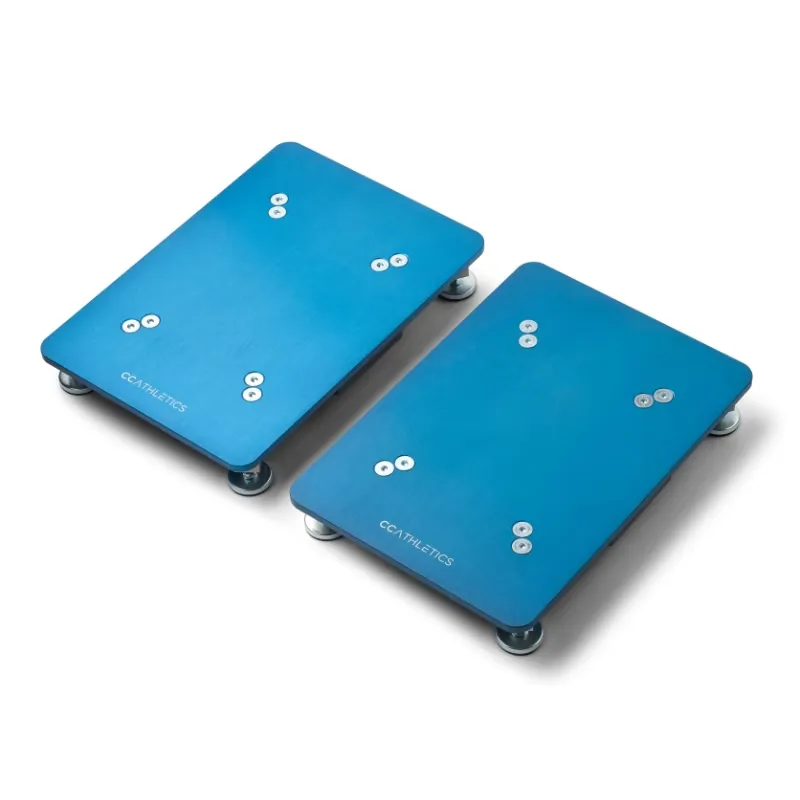
Because RFD lives in the first fractions of a second, it needs a high sampling rate to capture cleanly. The PlateMate records the force-time curve at up to 960 Hz (nearly a thousand readings a second) and computes RFD alongside peak force and left–right asymmetry in ForceMate, with the onset detection that makes those early-window numbers dependable. See what we measure for the full metric set.
In short
RFD is how fast an athlete builds force: explosive strength, the slope of the force-time curve, in newtons per second. It’s often more relevant to sport than peak force, but it’s fragile. Get the onset and the method consistent, read it as a trend, and it becomes one of the most useful numbers on the curve.
Want to see RFD measured cleanly in your setting? Get in touch with the CC Athletics team.
Frequently asked questions
What is rate of force development (RFD)?
Rate of force development (RFD) is how quickly an athlete produces force: the change in force divided by the change in time, which is the slope of the force-time curve. It is measured in newtons per second (N/s) and is often called explosive strength.
Why does RFD matter?
Most explosive sporting actions (a sprint foot-strike, a jump take-off, a change of direction) happen in well under 250 milliseconds, which is less time than it takes to reach peak force. So how fast an athlete builds force often matters more than their maximum. Two athletes with the same peak force can have very different RFD. In rehabilitation, RFD also recovers more slowly than maximum strength, which makes it a useful return-to-play marker.
How is RFD calculated?
From the force-time curve, usually over set windows from the start of the contraction (for example 0–100 or 0–200 ms): RFD equals the force gained by the end of the window divided by the window's length. Reaching 1,700 N in the first 100 ms is 1,700 ÷ 0.100 = 17,000 N/s. Peak RFD is the steepest part of the curve, taken over a short (~20 ms) window.
What are the RFD time bands (0–100, 0–200 ms)?
RFD is reported over windows measured from movement onset. Early windows (the first ~100–150 ms) mainly reflect neural drive (how quickly the nervous system recruits muscle), while later windows blend in the athlete's maximal strength and are more reliable. RFD is only comparable within the same window and method; a 0–100 ms value and a 0–200 ms value are different things.
Is RFD reliable?
Less reliable than peak force. RFD is very sensitive to how the start of the contraction (the onset) is detected and to signal noise, especially in the early windows. It is best read as a trend within an athlete, using a consistent method, rather than as a single one-off number.
How do you measure RFD?
On a force plate, from tests such as the isometric mid-thigh pull (IMTP) or a countermovement jump: the plate records the force-time curve hundreds of times a second and the software computes RFD over the chosen windows. A clean, still baseline before the effort is what makes the onset, and therefore the RFD, trustworthy.
The product behind this article
PlateMate
Dual Force Plates
Explore PlateMate →